Review: 'Canvas to Clay' at SAMA
SAMA pairs O'Keeffe with Maria Martinez pottery and Mexican ceramics. A quiet show that rewards slow looking.
Zereshk · CC BY-SA 3.0
Glasstire called "Canvas to Clay" at the San Antonio Museum of Art "deceptively quiet," and that's exactly right. This is not a show that announces itself with scale or spectacle. It announces itself by asking you to slow down — and then rewarding you for it.
The exhibition is anchored by two superstars who were born the same year (1887), lived nearly a century each, and became synonymous with the American Southwest through radically different media. Georgia O'Keeffe painted the desert — its flowers, its bones, its vast horizontal light — and became the most famous American woman artist of the twentieth century. Maria Martinez, of San Ildefonso Pueblo in New Mexico, shaped the desert's clay into vessels that redefined what pottery could be and became the most celebrated Native American artist of her era.
## The Black-on-Black Revolution
Martinez and her husband Julian didn't invent black-on-black pottery, but they perfected it. The technique involves coating a vessel with a fine clay slip, burnishing it to a high polish, painting designs with refractory clay, and then firing it in a reducing atmosphere — smothered with wood and, historically, even animal manure — so that carbon penetrates the surface and turns it a deep, lustrous black. The painted designs, unburnished, appear matte against the polished surface. The visual effect is subtle and arresting: pattern emerging from darkness, visible only when the light catches it at the right angle.
SAMA's installation places Martinez vessels alongside O'Keeffe's paintings in the Steves Gallery, and the conversation between them is immediate. Both artists were obsessed with form reduced to its essence. Both found in the Southwest landscape a visual vocabulary that was simultaneously modern and ancient. And both — in very different art worlds, facing very different obstacles — achieved a level of recognition that transcended their respective categories. O'Keeffe was more than a "woman painter." Martinez was more than a "craft artist." The show lets their work speak to each other without forcing the parallels.
## South to Chihuahua and Jalisco
What elevates "Canvas to Clay" beyond a two-artist pairing is SAMA's decision to extend the conversation south. The exhibition includes ceramics from Mata Ortiz, the small town in Chihuahua, Mexico, where potters revived the ancient Casas Grandes tradition beginning in the 1970s — a story of cultural recovery that parallels Martinez's own revival of Pueblo pottery techniques. And from Tonala, Jalisco, the show includes hand-burnished ceramics that connect the Mexican and Southwestern traditions across the border.
The curators invite what they call "slow looking" — a phrase that echoes O'Keeffe's own belief that most people don't really see what's in front of them. "Nobody sees a flower — really — it is so small it takes time," she wrote. "We haven't time — and to see takes time, like to have a friend takes time." The exhibition design supports this: the Steves Gallery is intimate, the lighting warm, the labels minimal. You're meant to stand with a single Martinez vessel for as long as you would with an O'Keeffe painting. The experience is less like visiting a museum and more like visiting a friend's private collection.
## San Antonio's Position
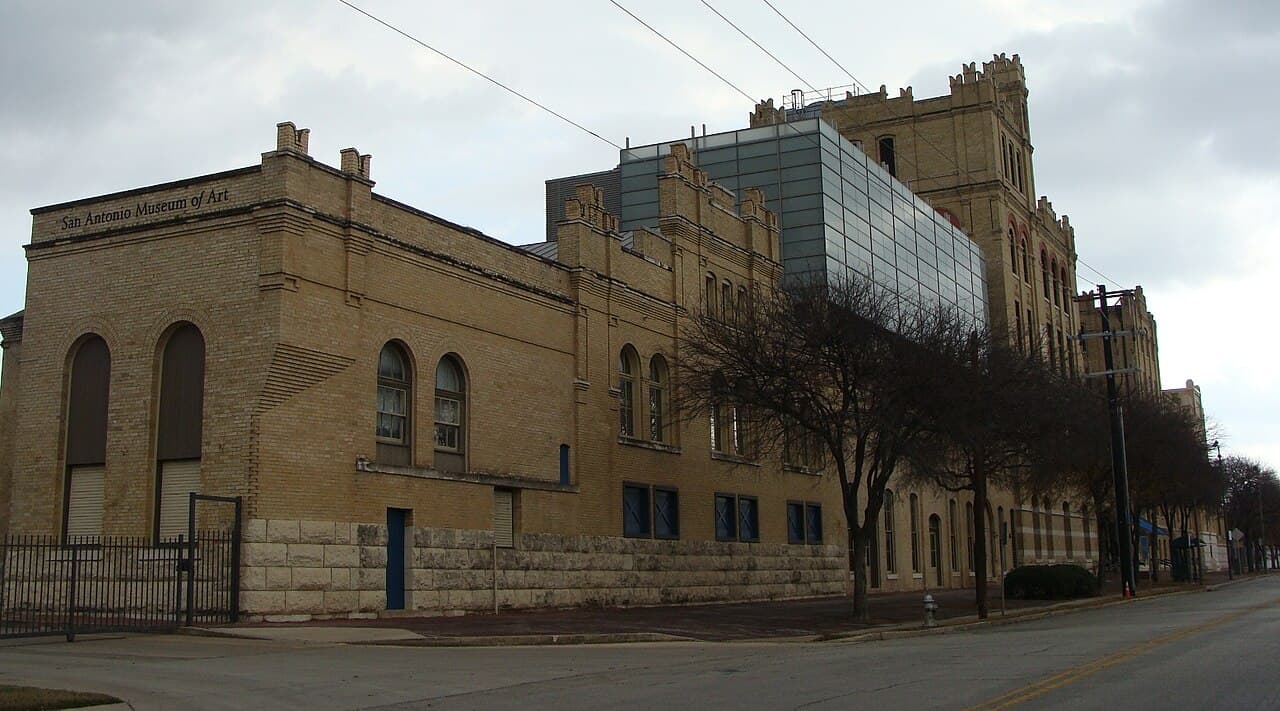
San Antonio's position between the United States and Mexico makes this pairing feel inevitable — even overdue. This is a city where the border isn't an abstraction. It's family, history, commerce, food, language. SAMA, housed in the old Lone Star Brewery on the Museum Reach of the River Walk, has always had one foot in each world. "Canvas to Clay" makes that positioning explicit, drawing a line from San Ildefonso Pueblo through the Chihuahuan Desert to Jalisco and asking viewers to see a continuous tradition rather than a set of national categories.
"Canvas to Clay" is on view at SAMA through August 2026. Admission varies; check samuseum.org for hours and pricing. For more on San Antonio's full art landscape, our guide to the city's five essential art spaces covers Ruby City, the McNay, Blue Star, and more.