Review: Cauleen Smith at CAMH
Cauleen Smith's CAMH survey is the must-see Houston show of summer 2026. Film, textiles, and radical generosity.
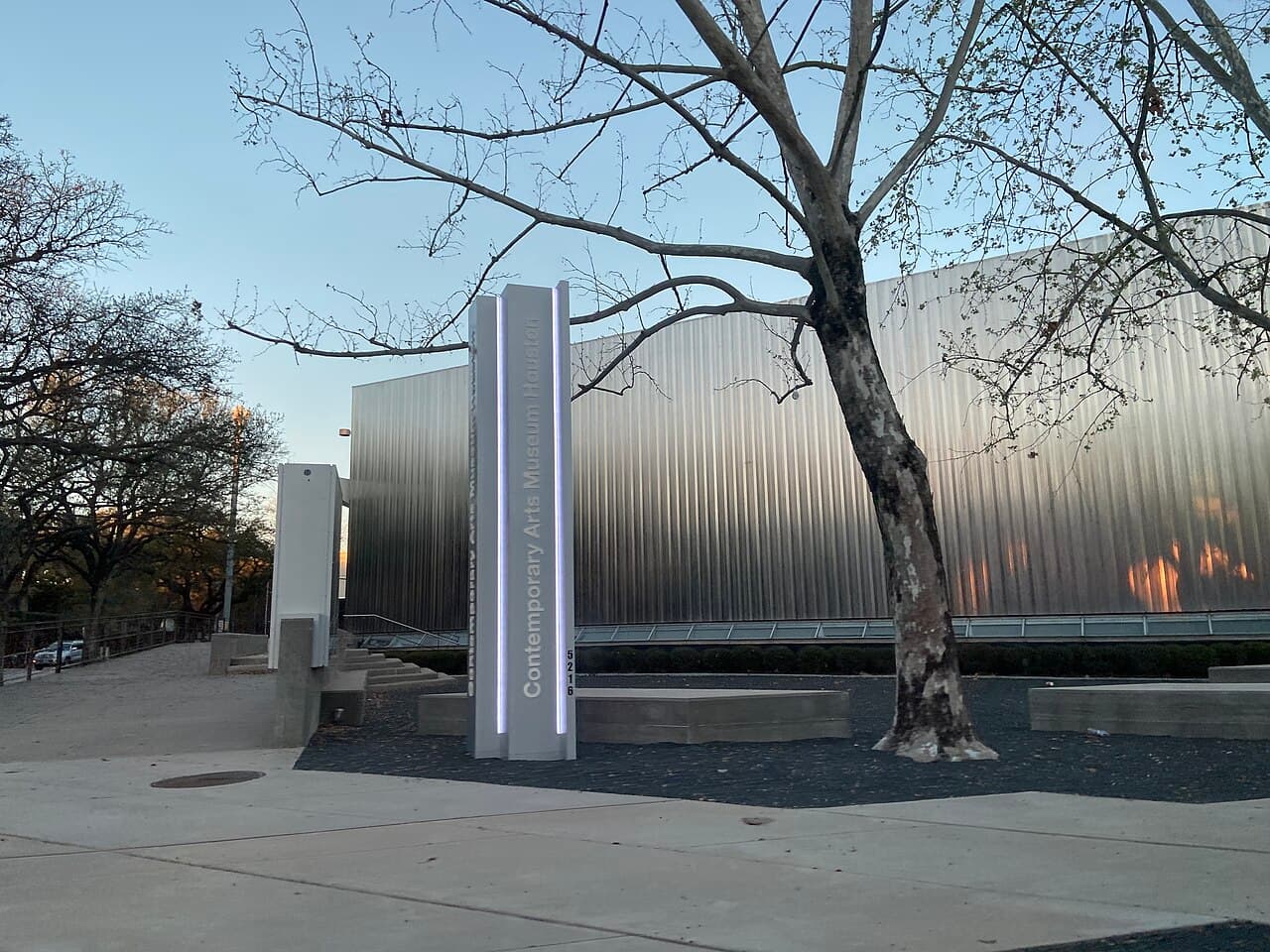
The first thing you notice, walking into CAMH for Cauleen Smith's "We Already Have What We Need," is the building itself. Gunnar Birkerts designed the Contemporary Arts Museum Houston's stainless-steel structure in 1972 — faceted, trapezoidal, a building that seems to hum with suppressed energy. Inside, the two main galleries have no permanent collection to anchor them, no paintings on permanent loan, no institutional ego to accommodate. Everything depends on the artist. Smith understands this, and she uses it.
"We Already Have What We Need" fills both galleries with an interlocking web of film projections, hand-dyed banners, assemblage sculptures, drawings, and a site-specific installation that turns CAMH's unusual architecture into something luminous and strange. This is the kind of exhibition that mid-career surveys rarely achieve: genuinely cumulative, where each element reshapes the meaning of the others. Glasstire has tracked the show's critical reception from opening day, and the consensus is unambiguous: this is the must-see exhibition of Houston's summer.
The films are the gravitational center. Smith works in 16mm and Super 8 alongside digital video, and the texture of the celluloid carries weight here — it makes the footage feel archival even when it isn't. One film weaves together footage of Sun Ra performances, marches, speculative science fiction imagery, and domestic interiors in a collage that resists chronology. Sun Ra, whose music Smith has long engaged with, appears not as subject but as method — his cosmic, utopian vision of Black creativity applied to the act of filmmaking itself. The result isn't documentary. It's closer to fugue: a set of themes that modulate and return, never quite resolving.
The textile works operate differently. Smith's banners, dyed in deep indigos, turmeric yellows, and rust, hang from the ceiling at intervals that create ceremonial passageways through the galleries. They look processional, votive, like they belong at the same crossroads where the films are set. The assemblage sculptures — small altars built from found objects, printed matter, and craft materials — extend the same logic into three dimensions.
What Smith is making, across all these modes, is a speculative history: a version of Black American experience and futurity that doesn't require trauma as its engine. The title is a declaration rather than a question. We don't need someone to give us art, or freedom, or a future — we already have what we need to build them.
Also on view at CAMH through November: Jordan Strafer: Trilogy, the New York video artist's first solo museum exhibition, presenting three interconnected films that blend memoir, mythology, and institutional critique. The pairing of Smith and Strafer across CAMH's two floors makes for one of the stronger institutional arguments the museum has mounted in years. Both exhibitions are free. CAMH has never charged admission in its 75-plus year history — a fact worth saying out loud, given that the shows on view are as rigorous as anything you'll find in a ticketed museum anywhere. For more free art across the city this summer, our full guide to free Houston art events covers everything from the Menil campus to Sawyer Yards open studios.
CAMH is located at 5216 Montrose Blvd, Houston, TX 77006. Open Tuesday–Wednesday and Friday–Saturday 10am–5pm, Thursday 10am–9pm, Sunday noon–5pm. "We Already Have What We Need" runs through October 3.