Donald Judd's Block: A Life Designed in Marfa
Inside Judd's Block: the Marfa residence with adobe walls, a 13,000-volume library, and self-designed furniture.
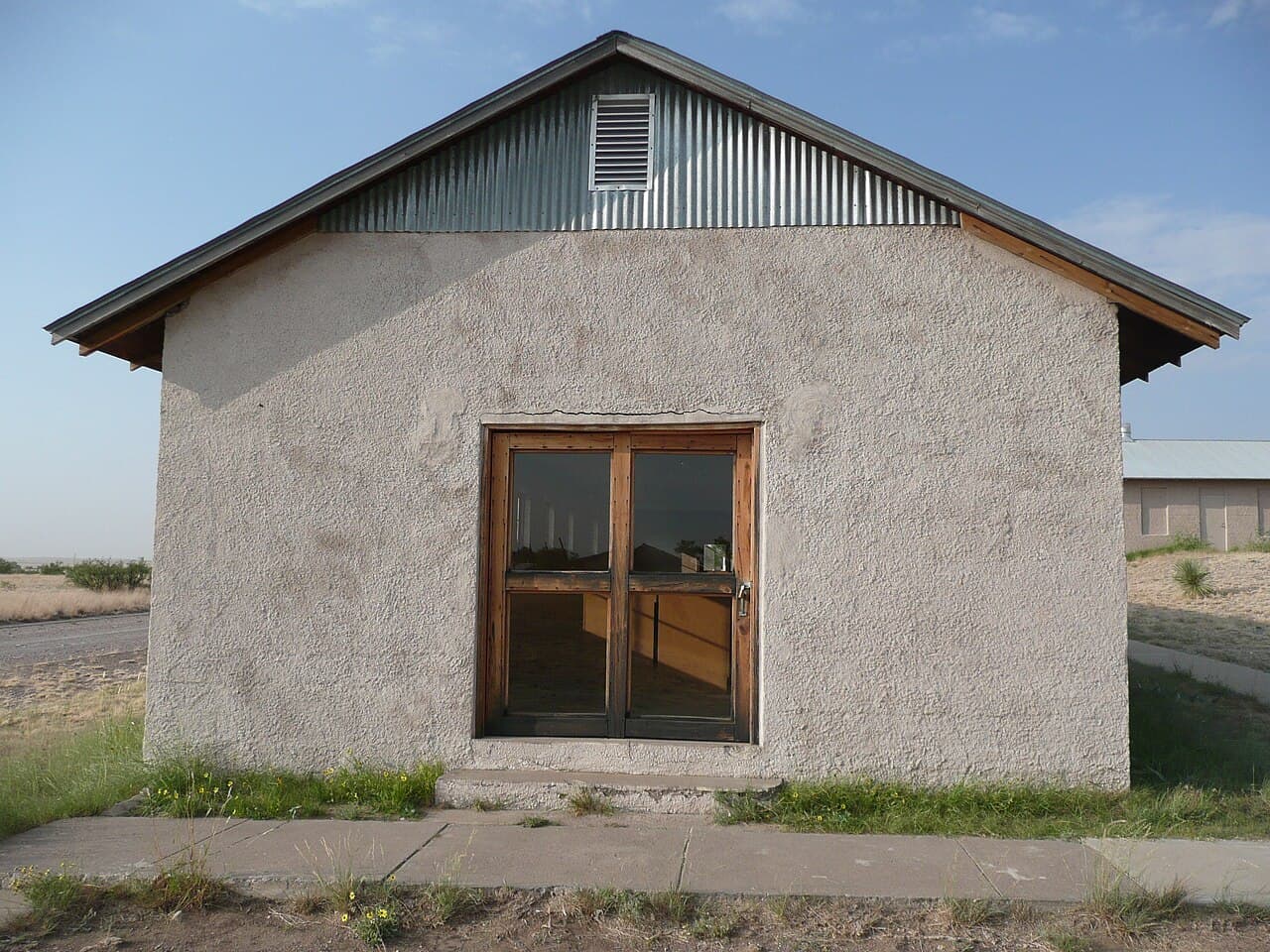
Fapharis · CC BY-SA 3.0
The first thing you notice about the Block is the wall. Adobe, thick and sun-bleached, running the full perimeter of a city block in downtown Marfa. Behind it, invisible from the street, is the compound that Donald Judd assembled between 1973 and his death in 1994 — a complex of buildings, courtyards, gardens, and interior spaces that constitute the most complete surviving record of how one of the twentieth century's most important artists actually lived.
La Mansana de Chinati — "the Block of Chinati," named for the Chinati Mountains visible on the southern horizon — comprises two large hangars that Judd converted for art display, a two-story former U.S. Army Quartermaster Corps building that became his residence, and several smaller structures. The property occupies an entire block bounded by Lincoln, Dean, Spring, and Highland streets. Judd purchased the buildings in 1973-74, when Marfa was still a quiet ranching town and real estate cost almost nothing. He spent two decades shaping the compound with the same precision he brought to his sculptures.
The adobe walls are not decorative. Judd used local construction techniques and local materials — the same methods that had been building structures in the Chihuahuan Desert for centuries. The walls regulate temperature, absorb and release heat, and create a microclimate inside the compound that is noticeably cooler than the streets outside. They also establish a boundary: the Block is a private world. You enter through a gate, and the town disappears.
## The Residence
The Quartermaster Corps building — two stories, thick walls, high ceilings — is where Judd lived when he was in Marfa. The interior is austere but not ascetic. Every object is placed with intention. There is no clutter, no decoration in the conventional sense, but there is warmth — the warmth of sunlight on adobe, of well-made objects in a well-proportioned room, of a space designed by someone who understood that comfort and rigor are not opposites.
The art on the walls dates primarily from the 1960s and 70s — works by Judd's contemporaries, acquired through exchange or purchase, installed permanently. They have been in the same positions for decades. The relationship between the art and the architecture is not accidental; Judd chose each placement as carefully as he chose the placement of his aluminum boxes at Chinati.
## The Furniture
This is where the Block becomes something more than a preserved artist's home. It becomes evidence of a philosophy.
Judd's first furniture piece was a bed, designed in 1970 for his loft at 101 Spring Street in SoHo. The reason was blunt: he couldn't find a bed he wanted to sleep in. The commercially available options were, in his judgment, badly designed — aesthetically compromised, structurally dishonest, made to look like something they weren't. So he designed his own. Then a sink. Then, in Marfa, the project expanded: chairs, desks, shelves, tables, daybeds, bookcases.
The early pieces were rough. Lumberyard pine, cut to specification, assembled with visible joinery. They had the quality of prototypes — functional, proportionally considered, but not refined in the way that his sculptures were refined. This was deliberate. Judd was not interested in luxury furniture. He was interested in honest furniture: objects that expressed their materials, their construction, and their function without pretense.
Over the following two decades, the furniture evolved. Judd began working with craftspeople around the world, exploring different materials — Douglas fir, Baltic birch plywood, anodized aluminum, copper, Cor-Ten steel — and different construction techniques. The later pieces are exquisite: precise, warm, perfectly proportioned. A Judd pine chair from the late 1980s has the same quality of inevitability as a Judd wall sculpture — the sense that it could not be any other way, that every dimension has been tested and resolved.
By 1994, Judd had produced nearly 100 furniture designs. They fill the Block: the bedrooms, the kitchen, the library, the studios. Walking through the compound, you encounter them not as museum objects behind ropes but as furniture in use — or at least, furniture that was in use until February 12, 1994, when Judd died of lymphoma at 65, and everything stopped exactly where it was.
The furniture is now collected and exhibited internationally. Lehni, in Switzerland, produces authorized editions. Individual pieces sell at auction for six figures. But seeing them in a gallery or a collector's apartment is a fundamentally different experience from seeing them at the Block, where they exist in the context Judd designed them for — alongside his art, his books, his architecture, in the light he chose.
## The Library
Thirteen thousand volumes. Art, architecture, philosophy, mathematics, natural history, poetry, fiction. The shelves are Judd's design, naturally. The books are arranged by Judd's own system, which is not the Dewey Decimal System. They have not been reorganized since his death.
The library tells you what kind of mind you're dealing with. This was not a casual reader. The breadth is staggering — from Wittgenstein to field guides to the plants of the Trans-Pecos, from Le Corbusier to Larry McMurtry. Judd read seriously and across disciplines, and the library reflects the same conviction that animated his art and his furniture: that the boundaries between fields are artificial, that architecture and sculpture and furniture and landscape are not separate disciplines but facets of a single practice.
## The Architecture Studio
Recently reopened after a seven-year restoration led by Schaum Architects, the Architecture Studio is one of the most intimate spaces in the Judd Foundation's Marfa properties. It's where Judd worked on architectural projects — renovations, furniture designs, spatial studies — and it has been restored to reflect its state during his working life. The drafting tables, the models, the material samples. Everything placed, as always, with intention.
The restoration itself is a statement about how seriously the Judd Foundation takes the preservation of context. They didn't simply repair the building. They studied photographs, interviewed people who had worked with Judd, and reconstructed the spatial relationships that Judd had established. The goal was not to create a museum but to restore a working environment — to let visitors see what it looked like when the architect was still at the table.
## The Thesis
Here's what the Block proves, and what no single sculpture or furniture piece can communicate on its own: Judd didn't just make art in Marfa. He designed a way of living with art.
The distinction matters. Plenty of artists live surrounded by their work. What Judd did was more systematic and more radical. Every object in every room — the furniture, the art on the walls, the books on the shelves, the cactus in the courtyard, the proportions of the windows, the thickness of the adobe — was selected or designed to participate in a unified environment. The Block is not a house with art in it. It is a single, continuous work that happens to be habitable.
This is the idea that Judd spent his career articulating: that art, architecture, furniture, landscape, and daily life are not separate disciplines but aspects of a single practice. The aluminum boxes at Chinati make the argument in sculptural terms. The Block makes it in domestic terms. You walk through rooms where a man ate breakfast, read philosophy, designed chairs, and installed art by his peers, and you understand — physically, spatially, in your body rather than in your head — that for Judd, there was no boundary between these activities. They were all the same activity: the careful, permanent arrangement of objects in space.
The books are where he left them. The furniture is where he placed it. The light comes through the windows at the angles he calculated. Everything is exactly as it was, except that the man who made it is gone, and the desert outside the adobe walls keeps doing what it has always done — shifting the light, slowly, from morning to afternoon to evening, across surfaces that were chosen to receive it.
## Visiting
Tours of the Block, the Architecture Studio, and the Art Studio are by appointment through the Judd Foundation. Book at juddfoundation.org/visit/marfa/. Allow 90 minutes to two hours. Photography policies vary by space — ask your guide.
For the full Marfa itinerary — Chinati, Ballroom, Prada Marfa, food, hotels, and the desert — our complete guide has everything. And for the annual gathering that brings the art world to West Texas, our Chinati Weekend guide covers the logistics.