San Antonio Art Scene: A First-Timer's Guide
Ruby City, the McNay, Artpace, Blue Star, and First Fridays — San Antonio's art scene runs on deep cultural heritage and bold contemporary vision.
By RedDot Texas
Nan Palmero from San Antonio, TX, USA · CC BY 2.0
San Antonio's art scene is unlike any other in Texas — and that is because it is rooted in something deeper than market forces or institutional ambition. The city sits at the intersection of Chicano, Tejano, and contemporary art traditions, and the result is a creative culture that feels both historically grounded and artistically fearless. Where Houston and Dallas have built their reputations on world-class museums and blue-chip galleries, San Antonio has built something different: an art ecosystem powered by deep cultural heritage, visionary patrons, and artists who refuse to separate their work from their community. Here is your cheat sheet.
## Ruby City
[Ruby City](/san-antonio/galleries/ruby-city) is the crown jewel of San Antonio's contemporary art scene — and one of the most extraordinary art spaces in the American South. Designed by David Adjaye (the architect behind the National Museum of African American History and Culture in Washington, D.C.), the building is a geometric marvel sheathed in precast concrete panels tinted a deep, luminous red. Inside, the Linda Pace Foundation's collection of over 1,400 works spans painting, sculpture, installation, and video by artists including Isaac Julien, Wangechi Mutti, Cornelia Parker, and Do Ho Suh. Ruby City is always free — no tickets, no reservations, just walk in. Currently on view: Tracey Rose (through May 2027), a major exhibition by the South African artist whose confrontational, politically charged performances and installations have made her one of the most important artists working on the African continent. Named one of Time's World's Greatest Places, Ruby City is reason enough to visit San Antonio.
## McNay Art Museum
The [McNay Art Museum](/san-antonio/galleries/mcnay-art-museum) holds a distinction that no other Texas museum can claim: it was the first modern art museum in Texas, founded in 1954 in the former residence of Marion Koogler McNay. The building itself — a stunning Spanish Colonial Revival mansion surrounded by 23 acres of landscaped grounds — is as much a work of art as anything inside it. The collection includes works by Georgia O'Keeffe, Pablo Picasso, Edward Hopper, and a deep holdings of prints, drawings, and theatre arts. Currently on view: Garden Party, an exhibition exploring the garden as artistic subject and metaphor, and untitled: 20 Years, marking two decades of the museum's contemporary wing with highlights from the collection.
## San Antonio Museum of Art (SAMA)
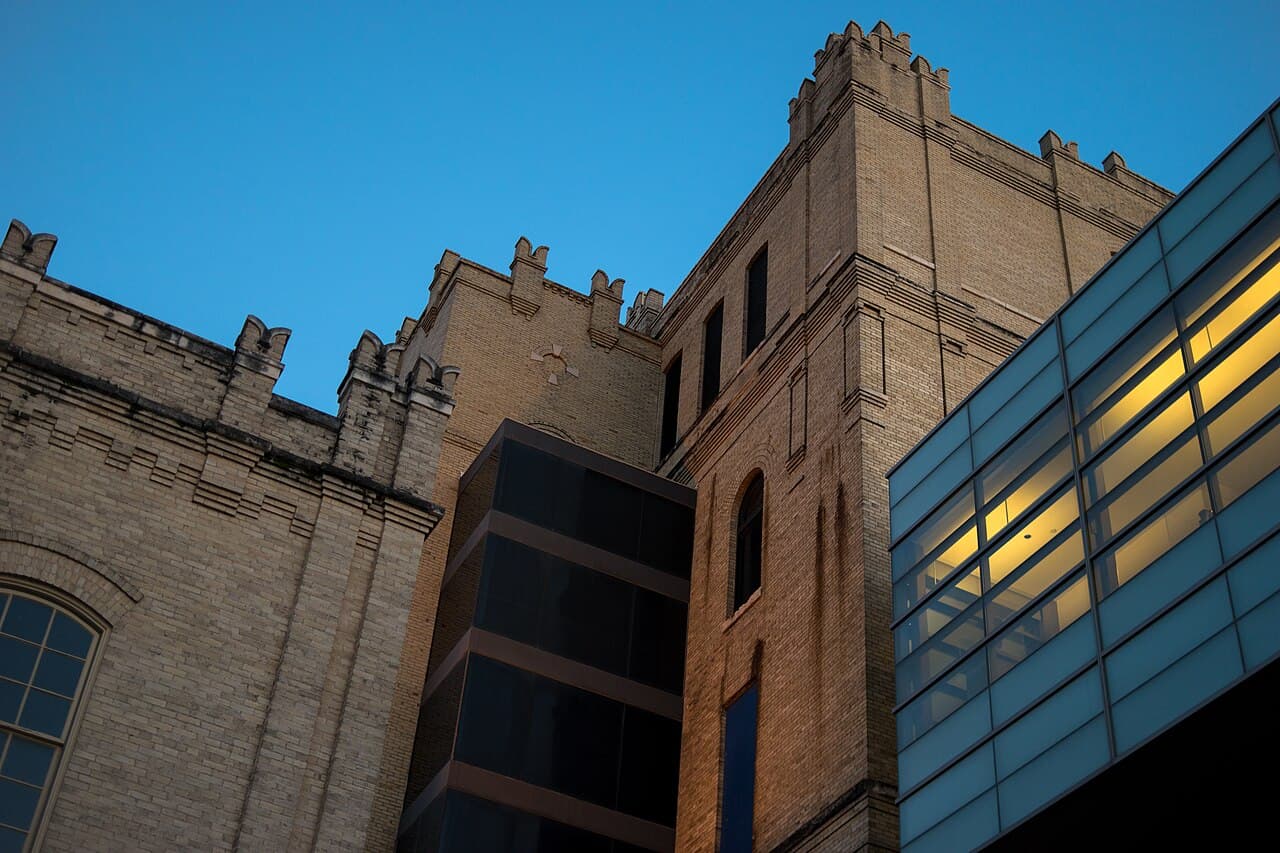
The [San Antonio Museum of Art](/san-antonio/galleries/san-antonio-museum-of-art) covers 5,000 years of art inside the former Lone Star Brewery — one of the most dramatic adaptive reuse projects in the state. SAMA's strengths are its Latin American, Asian, and ancient Mediterranean collections, which are among the finest in the region. The museum's ability to move from Egyptian antiquities to contemporary Latin American photography within a single visit gives it a range that few institutions in Texas can match. Currently on view: Canvas to Clay, an exhibition exploring the relationship between painting and ceramics across cultures and centuries.
## Artpace
[Artpace](/san-antonio/galleries/artpace) is the late Linda Pace's legendary artist residency program, and it operates on a model that is unique in the United States. Three times a year, Artpace selects one Texas artist, one national artist, and one international artist for an eight-week residency that culminates in a public exhibition. The result is a constantly rotating program of new, ambitious, site-specific work created specifically for the space. Spring 2026 residents: Violette Bule (Texas), Mel Chin (national), and Việt Lê (international). Artpace is always free and open to the public — it is one of the most important incubators of new art in the state, and visiting during a residency exhibition is like seeing art before the rest of the world catches on.
## Blue Star Arts Complex
The [Blue Star Arts Complex](/san-antonio/galleries/contemporary-at-blue-star) is the cornerstone of Southtown, the neighborhood that anchors San Antonio's gallery scene. The complex — a converted warehouse on the banks of the San Antonio River — houses Contemporary at Blue Star, FL!GHT Gallery, working artist studios, and a cluster of independent galleries and creative businesses. Blue Star has been the heart of San Antonio's contemporary art community since the 1980s, and its First Friday art walks — running continuously since 1994 — are the longest-running gallery walk tradition in the city.
## Southtown
Southtown is not just a neighborhood — it is the art experience. On First Fridays, thousands of people fill the streets south of downtown, moving between galleries, studios, pop-up exhibitions, and street vendors. The energy is communal, unpretentious, and distinctly San Antonio — you are as likely to encounter a Chicano muralist painting live as you are a gallery opening with wine and cheese. The San Antonio River runs through the neighborhood, adding natural beauty to the walk. Restaurants, bars, and taquerías line the route, making First Friday as much a social event as an art event. Even on non-First-Friday evenings, Southtown rewards a walk — the galleries are open, the murals are everywhere, and the neighborhood's creative energy is palpable.
## Free Options
San Antonio is arguably the most generous city in Texas when it comes to free art. Ruby City is always free. Artpace is always free. Contemporary at Blue Star is free. First Fridays are free. The McNay offers free admission on the first Sunday of each month. Between these options, you can spend an entire weekend immersed in world-class art — from David Adjaye architecture to cutting-edge residency exhibitions to a 30-year gallery walk tradition — without spending a dollar on admission.
## The Artists
San Antonio produces nationally significant artists at a rate that surprises people who have not been paying attention. Vincent Valdez — whose monumental paintings of Ku Klux Klan figures and Border Patrol agents have been acquired by the Blanton, the Smithsonian, and the Whitney — is San Antonio-born and trained. Cruz Ortiz blends graphic design, Chicano visual culture, and political activism into a practice that is as comfortable on a gallery wall as it is on a protest sign. Ana Fernandez paints the working-class neighborhoods of San Antonio's West Side with a tenderness and precision that has earned her national recognition. These artists — and dozens more like them — are the reason San Antonio's art scene punches so far above its weight.
For the complete list of what's happening this month, check San Antonio events. For detailed gallery profiles, browse San Antonio galleries. For free experiences, see free art in San Antonio.