San Antonio Westside Murals: A Walking Guide
San Antonio's Westside murals: 53 Chicano works on shop facades and community centers. A walking guide.
KenB · CC BY-SA 3.0
The murals on San Antonio's Westside are not street art. They are not a public art initiative funded by a downtown development authority. They are the result of a sixty-year argument about who gets to tell their own story — and where.
## The Roots
In the 1960s, the Chicano movement swept through Mexican American communities across the Southwest. The demands were concrete: better schools, fair wages, political representation, an end to discriminatory policing. But alongside the political organizing ran a cultural assertion — a refusal to let mainstream institutions define what Mexican American identity looked like, sounded like, meant.
Muralism became central to that assertion for a practical reason: galleries excluded Chicano artists. The major museums weren't showing this work. Commercial galleries weren't representing these artists. So the artists went outside. They painted on the walls of taqueriás, community centers, auto shops, churches, and apartment buildings. The wall became the gallery. The neighborhood became the museum. The audience was the community that lived there — not collectors, not curators, not critics.
This wasn't a San Antonio invention. The Chicano mural movement drew on Mexican muralism — Rivera, Orozco, Siqueiros — and on the political mural traditions of the Black Power movement. But San Antonio's Westside became one of its most sustained and concentrated expressions, because the neighborhood had both the need and the density to support it.
## San Anto Cultural Arts
Since 1994, San Anto Cultural Arts has formalized the tradition. The organization identifies, trains, and mobilizes local artists for large-scale murals across the Westside. Their approach is community-driven: murals are designed in collaboration with residents, and the painting process itself becomes a form of neighborhood engagement. Young people learn to prep walls, mix paint, scale designs. The murals don't just depict community — they create it.
Today there are 53 murals across the Westside, covering shop facades, community centers, school walls, and exposed brick surfaces. They illustrate cultural selfhood — the neighborhood's character made visible, made permanent, made public.
## The Key Works
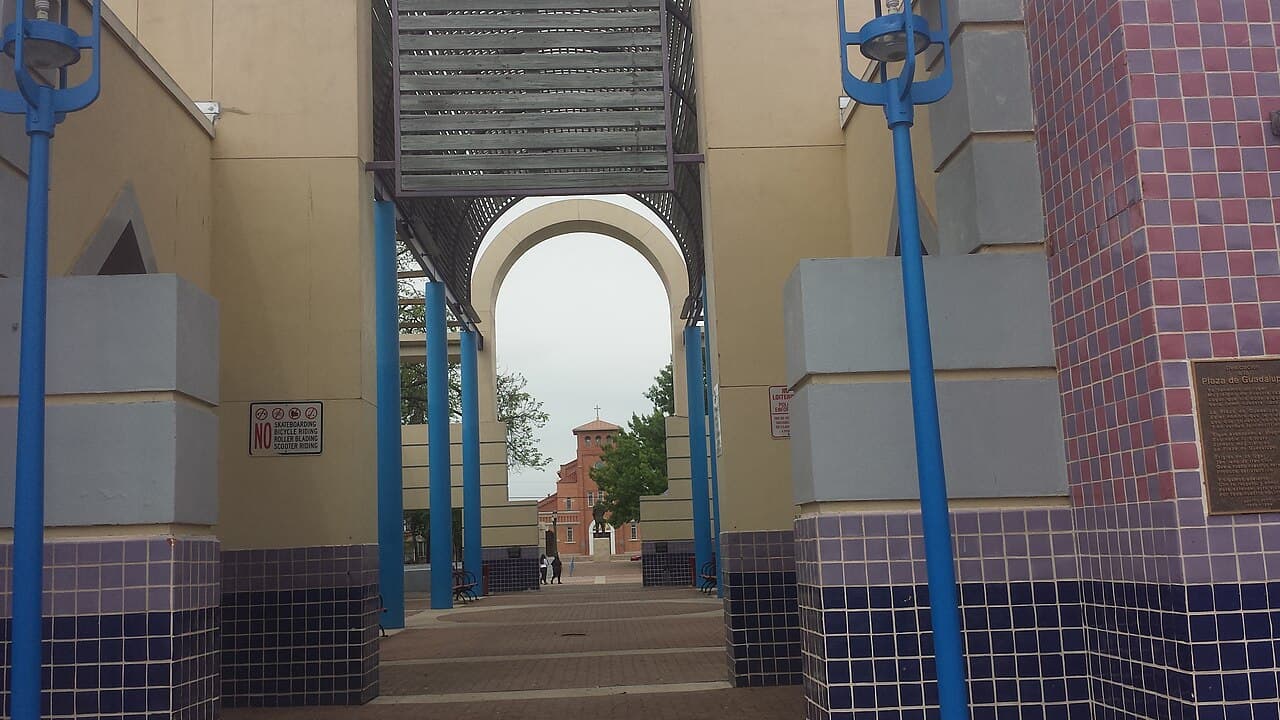
Jesse Treviño's "La Veladora of Our Lady of Guadalupe" stands at the Guadalupe Cultural Arts Center at 1300 Guadalupe Street. It is the largest Virgin Mary mosaic in the world — thousands of hand-placed tiles forming a devotional image visible from blocks away. Treviño, a Vietnam War veteran who lost his right hand in combat and retrained himself to paint with his left, is arguably San Antonio's most significant visual artist. The mosaic took years. It was a labor of faith in every sense.
The Guadalupe Cultural Arts Center itself, founded in 1980, is dedicated to the preservation and promotion of Chicano, Latino, and Native American arts — music, dance, theater, literature, visual art, and film. It is the institutional backbone of the Westside's cultural life.
"Comunidad Primero" is a 144-foot mural near the intersection of West Martin Street and I-10. Created through the Brick By Brick career program, it honors families, traditions, and everyday Westside life — the kind of subjects that sound sentimental in description but land with force on a wall that size. Brick By Brick combines artistic training with community collaboration, giving young artists both technique and purpose.
Cruz Ortiz — born in Houston in 1972, now living and working in San Antonio — is the figure who has done the most to revive Chicano muralism for a contemporary audience. A former Artpace resident, Ortiz works across print, performance, and film. His studio, Burnt Nopal, focuses on social justice and community engagement. His designs have appeared on the AT&T Center, on Absolut Vodka bottles, on protest signs and gallery walls alike. He is, in the best sense, an artist who refuses to choose between the street and the institution.
## The Esperanza
The Esperanza Peace and Justice Center, founded in 1987, is a Chicana-led cultural nonprofit on the Westside. It hosts concerts, poetry readings, art exhibitions, community organizing meetings, and cultural programming that connects the arts to the social movements that produced them. The Esperanza is not a gallery. It's a gathering place — the kind of space where culture and politics are understood as inseparable, because on the Westside, they always have been.
## Visiting
This isn't a gallery district. It's a working neighborhood. The murals are on the sides of buildings where people live, shop, worship, and raise families. Visit during daylight. Walk slowly. Read the murals the way you'd read any serious work of art — looking at composition, color, symbolism, and the relationship between the image and its site. Many of the murals include text, dates, and dedications. They are meant to be studied, not photographed from a car window.
There is no admission fee. There are no hours. The Westside is open the way a neighborhood is open — which is to say, you're welcome, but you're a guest.
For the full context of San Antonio's art scene — the institutions, the River Walk sculpture, the Southtown galleries — our complete city guide connects all the pieces.