San Antonio Art Guide: The Complete 2026 Scene
San Antonio art runs deep: Artpace, Ruby City, 53 Westside murals, Blue Star, and a River Walk lined with sculpture.
Zereshk · CC BY-SA 3.0
San Antonio doesn't pitch itself the way Houston does. There's no $1.3 billion arts industry stat, no count of international galleries opening branches. The art here grew from a different soil — three hundred years of Spanish missions, a Chicano movement that turned brick walls into museums, a single patron whose dream became a building, and a converted warehouse where artists have been opening their doors on First Fridays since Bill Clinton's first term.
The result is a city whose art scene has a coherence that larger, wealthier cities struggle to match. Every institution here knows what story it's telling. And those stories connect.
## The Institutions
Ruby City is the one that stops you. David Adjaye designed the building — precast concrete panels embedded with ground red glass and red Mexican lava rock, so the exterior shifts between crimson and rust depending on the light and the hour. Inside, 1,400 works from the Linda Pace Foundation span painting, sculpture, installation, and video. The collection is strong on Latin American and Texas-based artists, and Adjaye's interior spaces — clerestory windows, polished concrete floors, galleries that open onto each other at unexpected angles — give even familiar works a different charge. It has been free since it opened in 2019 and will remain so. Our full Ruby City guide covers what's on view and how to plan a visit.
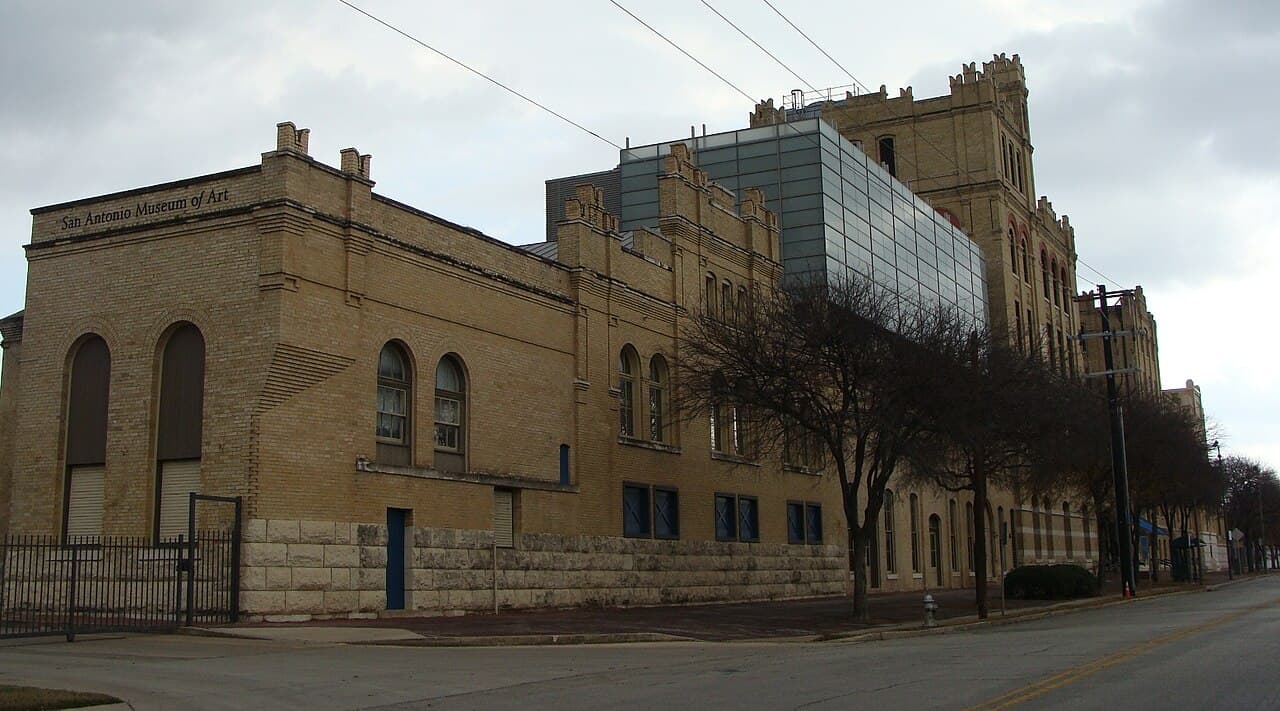
The San Antonio Museum of Art occupies the former Lone Star Brewery on the banks of the San Antonio River — an 1884 industrial building converted in 1981, with the original smokestack still standing. The permanent collection covers 5,000 years, but SAMA's real distinction is its Latin American holdings, the strongest of any museum outside Houston. "Canvas to Clay" pairs Georgia O'Keeffe paintings with Maria Martinez pottery and extends the conversation into Mexican ceramics from Chihuahua and Jalisco — a deceptively quiet show that opens up entire fields of connection if you let it.
The McNay Art Museum was the first modern art museum in Texas when it opened in 1954, and it still occupies the Spanish Colonial Revival mansion that Marion Koogler McNay built on 23 acres north of downtown. The Tobin Theatre Arts Collection — stage designs, costumes, rare prints — is one of the finest in the country. This summer, "Tony Walton: Designer of Dreams" showcases the legendary theatrical designer's work. The grounds alone are worth the trip: formal gardens, fountains, sculpture courts, and the particular quality of South Texas light filtering through live oaks.
Artpace, founded by Linda Pace in 1995 in a 1920s Hudson auto dealership, runs one of the most consequential artist residency programs in the Americas. The International Artist-in-Residence model — one Texas artist, one from elsewhere in the U.S., one international, selected by a guest curator three times per year — has hosted over 250 artists across 18,000 square feet and five exhibition spaces. The alumni list is staggering: 4 Turner Prize winners, 9 MacArthur Fellows, 15 Guggenheim Fellows, and more than 84 artists who have gone on to the Venice Biennale or Whitney Biennial. Spring 2026 residents are Violette Bule (Houston), Mel Chin (North Carolina), and Việt Lê (Vietnam), curated by Dr. Aleesa Pitchamarn Alexander. On view through July 12. Free. Our deep dive on Artpace's 30-year history tells the full story.
The Briscoe Western Art Museum on the River Walk is running "Tejanos Legacy: Another American Origin Story" — the largest exhibition the museum has ever mounted. Timed to the 250th anniversary of the United States, the show assembles over 100 artworks and artifacts spanning three centuries of Tejano identity. In a city built on that identity, the show feels less like a special exhibition and more like a civic reckoning.
## Southtown & Blue Star
The Blue Star Arts Complex at 1420 S. Alamo Street is the physical center of San Antonio's gallery scene. It's a converted warehouse on the San Antonio River — raw concrete, exposed ductwork, the kind of building that was cheap enough for artists to colonize in the early 1990s and has since become indispensable. Inside: Contemporary at Blue Star, FL!GHT Gallery, and more than a dozen independent studios. First Friday has been running here since 1994, 6 to 10 PM, with live music, food vendors, and the particular energy of a neighborhood that actually uses its art spaces rather than just visiting them. Second Saturday events extend the rhythm.
Southtown encompasses several neighborhoods — King William, Collins Garden, Lavaca, Lone Star, Roosevelt — but the walkable core is about six blocks. King William, the adjacent historic Victorian district, has small galleries and designer studios threaded through a preservation zone where architecture and commerce coexist. The ten-minute walk from Blue Star to Ruby City is, quietly, one of the best art walks in Texas. Our full Southtown and Blue Star guide maps the route.
## The Westside Murals
The Westside has 53 murals, and they didn't come from a beautification committee. They came from the Chicano movement.
In the 1960s, Mexican American communities across the Southwest were fighting for self-determination — labor rights, educational equity, political representation — and reclaiming a cultural history that mainstream institutions had ignored. Muralism became a form of resistance because galleries wouldn't show Chicano artists. If you couldn't get inside the museum, you painted the wall outside. The wall became the museum.
Since 1994, San Anto Cultural Arts has formalized that tradition, identifying, training, and mobilizing local artists for large-scale murals across the Westside's shop facades, community centers, and exposed brick walls. The murals illustrate cultural selfhood — portraits of families, celebrations of traditions, assertions of identity. They are not Instagram backdrops. They are community documents.
"Comunidad Primero" is a 144-foot mural near the intersection of West Martin and I-10, honoring families, traditions, and everyday Westside life. Created through the Brick By Brick career program, it represents both artistic training and community collaboration at scale.
Jesse Treviño's "La Veladora of Our Lady of Guadalupe" mosaic at the Guadalupe Cultural Arts Center is the largest Virgin Mary mosaic in the world — a devotional work rendered in thousands of tiles, visible from blocks away.
Cruz Ortiz — born in Houston in 1972, now a San Antonio institution — is a former Artpace resident whose work in print, performance, and film has revived Chicano muralism for a new generation. His studio, Burnt Nopal, focuses on social justice, and his designs have appeared on everything from the AT&T Center to Absolut Vodka bottles. Our full walking guide to the Westside murals covers the history, the key works, and the route.
## The River Walk
Most visitors know the River Walk as a strip of restaurants south of downtown. The art is on the extensions.
Museum Reach, the northern stretch, runs three miles from the Lexington Avenue dam to the Pearl district. The public art program here is genuinely ambitious. "F.I.S.H." by Donald Lipski — a giant illuminated fiberglass goldfish suspended under the Camden Street Bridge — has become the stretch's unofficial mascot. "The Grotto" by Carlos Cortés is a Hill Country-inspired installation with hidden faces carved into rock and waterfalls cascading alongside the pedestrian pathway. "Sonic Passage" by Bill Fontana layers environmental sound recordings along the walk, changing with the time of day. The landscaping includes over 70,000 native plants — this is an ecological corridor as much as an art walk.
Mission Reach extends eight miles south from Lone Star Boulevard to Mission Espada, following the San Antonio River through the UNESCO World Heritage mission sites. "Mission Gates" — sculptural installations marking the entry to each of the four missions — anchor the public art program along this stretch. The San Antonio River Foundation has commissioned additional works along the route, creating one of the longest continuous public art corridors in the state.
The whole thing is free, walkable, and connects Blue Star to the downtown museums without a car.
## Where to Eat Near the Art
Rosella Coffee at Blue Star: third-wave coffee inside the arts complex. The quality is serious — single-origin pour-overs, seasonal espresso drinks — and the location means you can caffeinate between gallery visits without leaving the building.
Hot Joy in Southtown: Asian fusion that doesn't apologize for being loud, spicy, or eclectic. Brisket fried rice, dan dan noodles, sake cocktails. A good dinner spot after First Friday.
La Panadería on Houston Street: a Mexican bakery that draws lines for its conchas, bolillos, and café de olla. The pastry case alone is worth the detour, and the coffee program is better than it needs to be.
## Getting There
San Antonio International Airport is 15 minutes from Southtown — one of the shortest airport-to-art-district commutes in Texas. From Houston, three hours on I-10 — the closest major-city art trip you can make. From Austin, 90 minutes on I-35.
Start at Blue Star. Walk to Ruby City. Uber to the McNay. End at Artpace. That sequence covers the full range of what San Antonio does — from grassroots galleries to a world-class residency — and you can do it in a single day.