David Hockney in Houston: A Texas Tribute
David Hockney changed how we see the world. From Bradford to L.A., a tribute to the greatest living British artist.
Michael Barera · CC BY-SA 4.0
David Hockney was born on July 9, 1937, in Bradford, Yorkshire — a gray industrial city in the north of England that could not have been further from the swimming pools and palm trees that would come to define his art. He died on June 11, 2026, at his home in London, one month before his 89th birthday. Today, on what would have been that birthday, it seems worth saying something about what he left behind — and what Texas, specifically, holds.
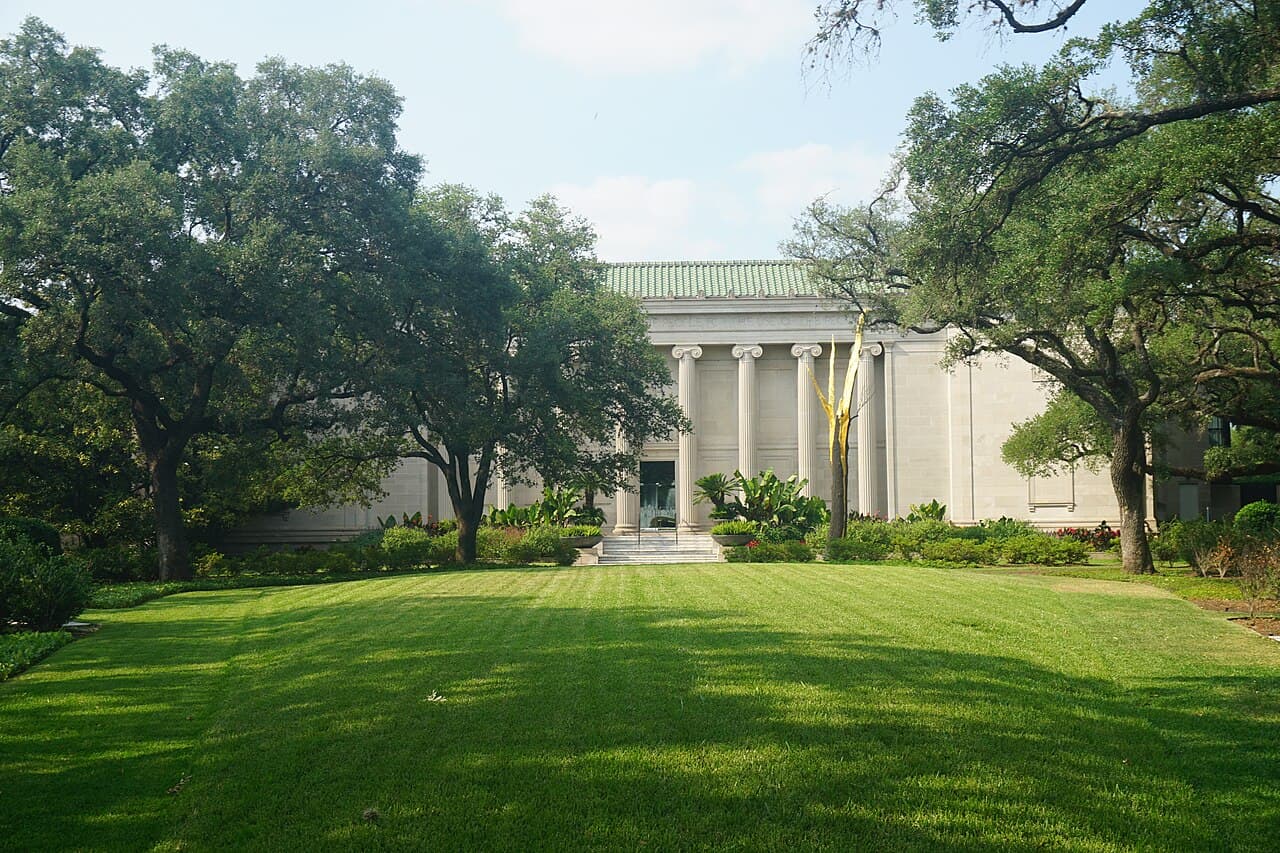
The Museum of Fine Arts, Houston owns 27 works by David Hockney. That number surprised me. The centerpiece is "The Four Seasons, Woldgate Woods" — a 36-channel video installation spread across 36 synchronized monitors, purchased by the MFAH in 2021, in which Hockney and his team filmed the same stretch of a Yorkshire country road through spring, summer, autumn, and winter using nine cameras at different angles. The result is not a nature documentary. It's a meditation on looking — on the way the human eye never rests at a single point but wanders, zooms, drifts. It is, in a word, Hockney. The collection also holds etchings from "The Blue Guitar" portfolio (1977), the 1964 etching "Edward Lear," and — characteristically — "A Bigger Fire" (2020), an inkjet print made from an iPad drawing, because Hockney never stopped reaching for whatever tool was newest and strangest.
The Modern Art Museum of Fort Worth owns "Adhesiveness" (1960), an oil on board from his student days at the Royal College of Art — the period when he was just beginning to make paintings about desire, identity, and the body at a time when homosexuality was still a criminal offense in Britain. The Dallas Museum of Art holds additional works. Between them, Texas has a quiet but real claim on one of the most important artists of the past century.
## The Pools, the Light, the Revelation
Hockney arrived in Los Angeles in 1964 and never entirely left. Bradford was cold and cramped and painted in shades of soot. LA was flat, warm, and saturated with a kind of light he had never experienced. He started painting swimming pools — not because he was particularly interested in swimming, but because the pools were surfaces that reflected light, refracted it, broke it into turquoise fractals. "A Bigger Splash" (1967), now at Tate Britain, is the painting that made him famous: a diving board, a pink building, a palm tree, and the frozen explosion of water left by a body that has already disappeared beneath the surface. The diver is gone. Only the splash remains. It is simultaneously the most joyful and most melancholy painting in postwar British art.
"Portrait of an Artist (Pool with Two Figures)" came in 1972 and became, in 2018, the most expensive work by a living artist ever sold at auction — $90.3 million at Christie's, after nine minutes of bidding. It nearly doubled the previous record. Henry Geldzahler and Christopher Scott followed at $49.5 million, and Christopher Isherwood and Don Bachardy at $44.3 million. The double portraits — two people in a room, their relationship legible in posture and distance — were among his greatest achievements: psychologically precise, compositionally daring, and entirely unsentimental about love.
## What the Art World Said
Tracey Emin's tribute was the one that stuck. She called him "a great artist and a wonderful man, who with the power of art changed the perception of Britishness. A proud chain-smoking homosexual, who flew the flag higher than any other British artist." Mark Wallinger called him "the best draughtsman since Picasso." King Charles — who had been a personal friend — said he was "a Yorkshireman through and through" and "one of life's true originals." Alex Farquharson, director of Tate Britain, said Hockney "taught us about the joy of looking, seeing things the rest of us failed to notice."
That last phrase — "the joy of looking" — is the one that gets closest to what Hockney actually did. His entire career was an argument that seeing is an active, generous, endlessly renewable act. The pools, the double portraits, the Yorkshire landscapes, the iPad drawings, the Normandy panoramas, the multi-canvas experiments, the photo collages, the fax art, the iPhone sketches — they were all investigations of the same question: what does it mean to really look at something?
## The Man Who Refused to Stop
Most artists find their style and refine it. Hockney found his style, abandoned it, picked up a Polaroid camera, built photographic collages, put down the camera, went back to painting, moved to Yorkshire, started filming landscapes on eighteen cameras simultaneously, picked up an iPhone, then an iPad, moved to Normandy during COVID, and painted a 90-metre digital panorama inspired by the Bayeux Tapestry documenting the view from his studio through an entire year. "A Year in Normandie" was made during lockdown on an iPad, and it contains over a hundred individual iPad paintings stitched into a continuous frieze of the changing seasons. He was 83 when he made it.
His final major exhibition, "David Hockney 25," opened at the Fondation Louis Vuitton in Paris in April 2025 and ran through September. It was the largest Hockney exhibition ever mounted — over 400 works across eleven rooms, spanning 1955 to 2025. He was personally involved in every aspect of the installation. His last show in London, "A Year in Normandie and Some Other Thoughts About Painting," opened at the Serpentine in March 2026, three months before his death. He never retired. He barely even slowed down. The output across his career was staggering: approximately 600 paintings, 3,000 prints and drawings, and hundreds of works in digital media.
He accepted the Order of Merit from Queen Elizabeth II in 2012 — an honor limited to 24 living members — but famously turned down a knighthood. He received the Legion d'Honneur from France earlier in 2026. He was elected to the Royal Academy in 1985. He exhibited at every major museum in the world. And he spent his last years painting the trees and ponds of Normandy on a tablet, sending images of spring blossoms to friends via email, insisting to anyone who would listen that the world was more beautiful than people realized, and that the act of paying attention to it was itself a form of art.
## What Texas Keeps
The MFAH's "Hockney–Van Gogh: The Joy of Nature" in 2021 was the only U.S. venue for that show — 47 Hockney works alongside 10 Van Gogh paintings, exploring how both artists used landscape as a vehicle for emotional and perceptual discovery. The "Four Seasons, Woldgate Woods" installation, purchased that same year, is a permanent holding. It's not the most famous Hockney. But it might be the one that best captures what he spent his life doing: training nine cameras on a single stretch of road and insisting that you look at it — really look at it — as the light changes, the leaves turn, the snow falls, and the blossoms come back.
Twenty-seven works in a Houston museum. A 1960 painting in Fort Worth from the year he was first learning how to paint desire. More in Dallas. Texas doesn't have a Hockney pool painting — those belong to Tate, to private collectors, to the permanent mythology of postwar art. But it has what came after the pools: the landscapes, the video experiments, the digital drawings, the evidence of a man who spent sixty-five years looking at the world and never once got bored of what he saw.
He would have been 89 today. His funeral was private — just his partner, Jean-Pierre Goncalves de Lima, and his great-nephew Richard. No public service. No spectacle. That tracks. Hockney's art was always generous, always open, always inviting you in. His life, when it mattered, was his own.
Tate has announced two forthcoming projects: a major retrospective at Tate Britain spanning seven decades, and a multimedia installation in Tate Modern's Turbine Hall. The MFAH's 27 works are on view as part of the permanent collection. For the full scope of what Houston holds — including the Menil, CAMH, and the 300 artists at Sawyer Yards — our complete guide to Houston's art scene is a starting point. But today, start with Hockney. Stand in front of those 36 screens in the MFAH and watch the road in Yorkshire change seasons. He made it for you.