Review: Olga de Amaral — To Weave a Rock at the MFAH
A 60-year career in gold, silver, and thread. The Colombian fiber artist's first major U.S. retrospective is monumental, luminous, and unmissable.
By RedDot Texas
Michael Barera · CC BY-SA 4.0
Olga de Amaral: To Weave a Rock at the Museum of Fine Arts, Houston is one of the most important exhibitions the museum has staged in years. Approximately 50 works fill the Kinder Building's upper-level galleries, tracing six decades of the Colombian artist's radical investigations into the woven form. This is Amaral's first major U.S. retrospective, and it arrives with the force of a revelation — even for viewers who think they know her work from reproductions. Nothing prepares you for the scale, the weight, and the sheer luminosity of these pieces in person.
The exhibition is organized into four thematic sections that trace Amaral's architectural investigations of fiber as a medium. The earliest works from the 1960s and 1970s reveal an artist already thinking beyond the loom — twisting, knotting, and layering natural fibers into three-dimensional forms that hover between textile and sculpture. These early pieces establish the vocabulary she would spend the next half-century expanding: repetition, accumulation, surface, and the tension between the handmade mark and the monumental scale.
Olga de Amaral is 92 years old and has been working for more than 60 years. She is widely considered one of the most important fiber artists alive — a designation that, while accurate, undersells the ambition of her project. She studied at Cranbrook Academy of Art in Michigan in the late 1950s, returned to Colombia, and built a practice that draws equally on pre-Columbian textile traditions and the formal concerns of postwar abstraction. Her work has been collected by the Met, MoMA, the Tate, and dozens of major institutions worldwide. This retrospective is long overdue.
The works that will stop you in your tracks are the gold and silver leaf pieces. Amaral applies sheets of precious metal to woven fiber surfaces, creating walls of shimmering material that shift and glow as you move around them. These are not decorative objects — they are monumental, often six or eight feet tall, with a physical presence that is closer to architecture than to craft. The gold catches ambient light and throws it back at you in ways that change with every step. Standing in front of a large Amaral gold piece is an experience that photography cannot capture — the interaction between your body, the light, and the surface is the work.
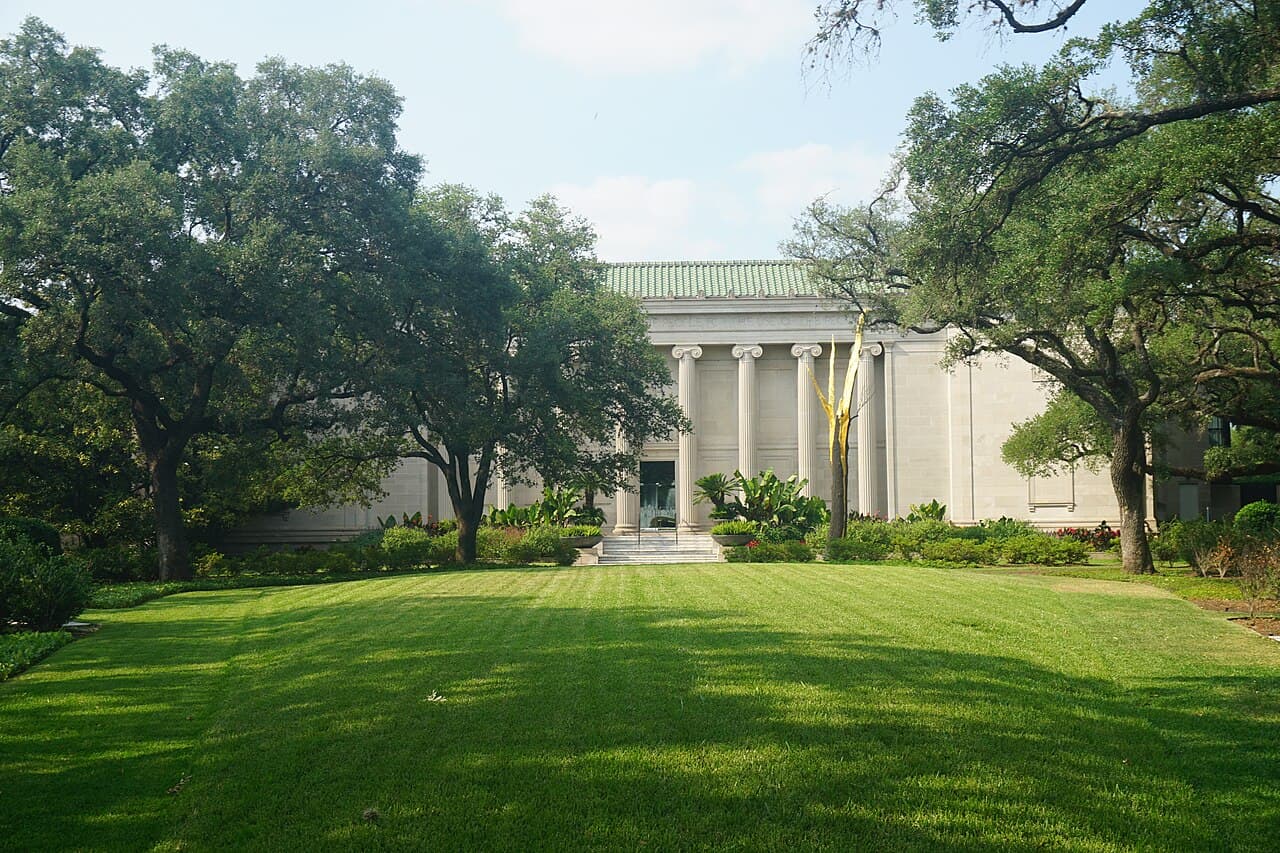
The Kinder Building is the ideal setting for this exhibition. Steven Holl's design floods the upper galleries with diffused natural light that activates the metallic surfaces in ways that artificial lighting alone could not achieve. The high ceilings give the monumental pieces room to breathe, and the clean, minimal architecture refuses to compete with the work. This is one of those rare cases where the building and the exhibition feel genuinely symbiotic — each making the other better.
What makes this show different from a painting exhibition is the insistence on materiality. Every piece in this show was made by hand — woven, knotted, wrapped, gilded. The surfaces invite close looking: you can see the individual threads, the places where gold leaf meets raw fiber, the subtle variations in tension and density that distinguish one passage from another. This is art that rewards patience and proximity. Step back and you see monumental abstraction; step forward and you see the evidence of thousands of hours of handwork. The oscillation between those two scales of perception is central to the experience.
Amaral's achievement is the elevation of craft to monumental art without abandoning the essential qualities of the handmade. She connects pre-Columbian textile traditions — the sophisticated weaving practices of Andean cultures — with the formal concerns of contemporary minimalism, creating work that belongs to both histories simultaneously. The retrospective makes this lineage visible in a way that individual pieces in collection galleries cannot.
The touring retrospective, organized in collaboration with international curators, places Amaral's work in the broader context of Latin American abstraction and global fiber art movements. Each of the four sections builds on the previous one, creating a narrative arc that reveals not just the evolution of a practice but the deepening of a singular artistic vision over six decades.
To Weave a Rock is unmissable. It is the kind of exhibition that reminds you why museums exist — to give you an encounter with art that cannot be replicated on a screen, in a book, or in any other format. The physicality of these works demands your presence. If you see one show at the MFAH this year, make it this one. And while you are in the museum, the America 250 exhibition on the lower level offers a compelling complement — another major show that rewards a full day at the museum.
See the full event listing for hours, tickets, and visitor information. This is a show that will be talked about for years — do not wait until the final weekend.