Women & Their Work: Austin's Art Institution
Women & Their Work: 46 years, 2,000 artists, a Smithsonian-archived legacy. Austin's feminist gallery, profiled.
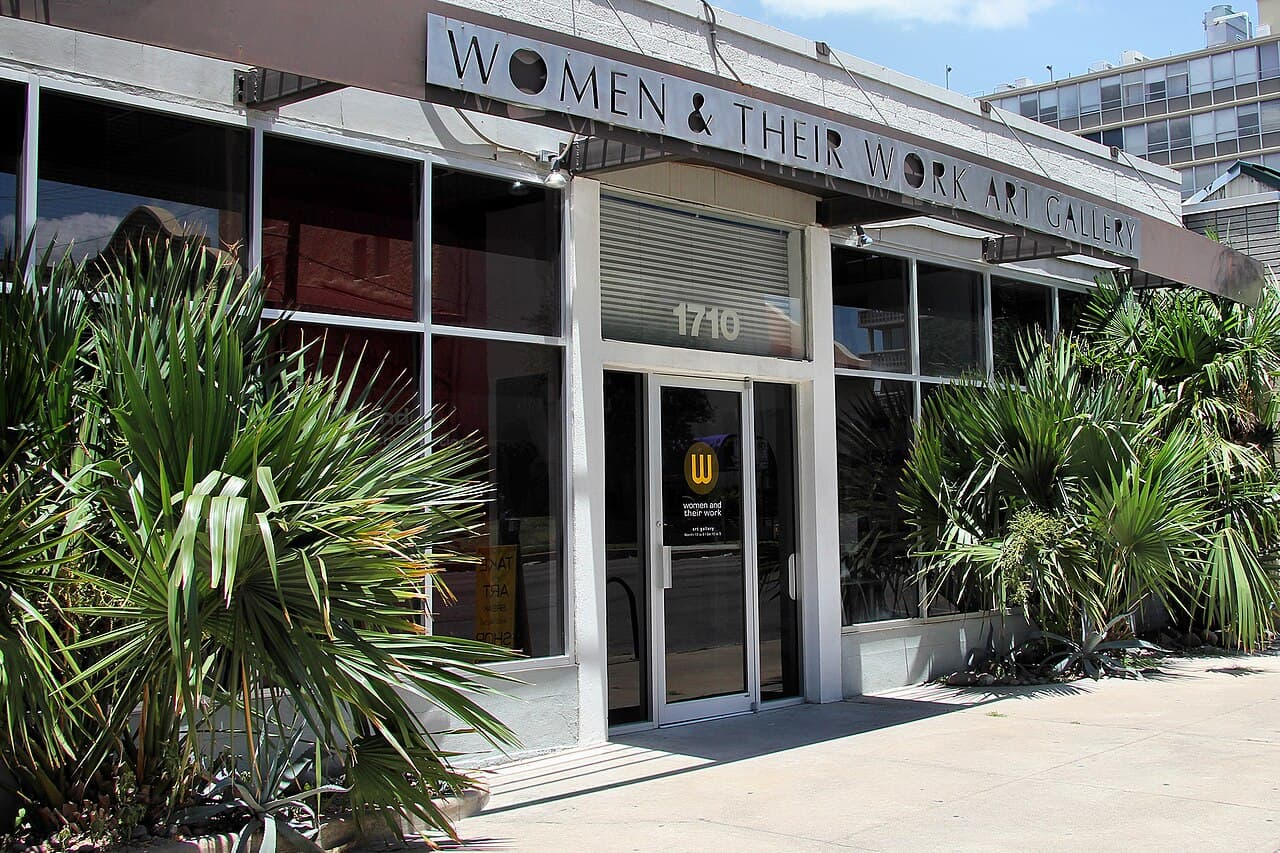
Larry D. Moore · CC BY 4.0
In 1978, three women in Austin looked at the art scene around them and didn't see themselves. Rita Starpattern, Deanna Stevenson, and Carol Taylor decided to build the thing that was missing.
They organized a six-week women's arts festival. It drew 20,000 people. That was supposed to be the end of it — a one-time event, a statement, a proof of concept. But 20,000 people showing up for something tends to change the plan.
## The Beginning
Women & Their Work incorporated in 1978, the same year as the festival. The organization's mandate was straightforward: create exhibition and performance opportunities for women artists in Texas. In a state where the major museums were overwhelmingly directed by men, showing work by men, collected by men, the need was not theoretical. It was visible in every gallery roster and museum calendar in the state.
In 1981, Women & Their Work received the first National Endowment for the Arts grant in visual arts ever awarded in Texas. That grant — from the federal government's primary arts funding body — validated what Starpattern, Stevenson, and Taylor had been arguing: that women's art in Texas deserved institutional support, not just good intentions.
The NEA grant was the beginning of a funding trajectory that would sustain the organization through decades of shifting political landscapes, economic downturns, and the chronic precariousness that defines nonprofit arts organizations everywhere. But Women & Their Work survived — and more than survived, it became essential.
## The Work
Over 46 years, Women & Their Work has presented hundreds of exhibitions across visual art, and hosted music, dance, theater, and film events that have given platforms to artists at every stage of their careers. The organization estimates it has developed the careers of more than 2,000 women artists — a number that encompasses emerging artists showing for the first time, mid-career artists gaining critical visibility, and established artists receiving the kind of sustained institutional attention that commercial galleries don't always provide.
The programming has always been intersectional in a way that feels genuine rather than performative. The exhibitions address race, class, sexuality, disability, immigration, and motherhood — not as curatorial themes imposed from the outside, but as the lived realities of the artists showing the work. Women & Their Work doesn't curate "about" these subjects. It shows artists who are living them.
The curatorial approach is deliberately accessible. The gallery space — currently at 1311 E Cesar Chavez Street in East Austin — is modest. It is not a museum. It is not a blue-chip gallery. The ceilings are not 20 feet high. The lighting is good but not theatrical. The walls are white but not intimidating. You walk in off the street and you're looking at art. That informality is strategic: it removes the barriers — psychological, economic, architectural — that keep people out of art spaces.
## The Smithsonian
In 2020, the Smithsonian Archives of American Art acquired the Women & Their Work archives. Forty-three years of exhibition records, correspondence, photographs, press materials, financial documents, and institutional history — preserved permanently in the national collection.
The Smithsonian acquisition is the kind of institutional recognition that validates decades of grassroots work. The Archives of American Art is the world's preeminent research center for the history of visual arts in America. Its holdings include the papers of Jackson Pollock, Georgia O'Keeffe, and Alexander Calder. For a small Austin nonprofit founded by three women who organized a festival to be archived alongside those names is not just an honor — it is an argument. It says: this work mattered. This history is American art history. These women, these exhibitions, these 2,000 artists whose careers were shaped by this organization — they belong in the permanent record.
## The Gallery Today
Women & Their Work presents monthly exhibitions of emerging and mid-career female artists, promoting them to a national stage. The space hosts opening receptions, artist talks, and community events that maintain the organization's founding commitment to accessibility. You don't need to know anyone. You don't need to be on a list. You just show up.
The current generation of Austin artists working in the gallery's orbit includes painters, sculptors, video artists, installation artists, and performance artists whose work reflects the full diversity of contemporary practice. Many of them cite Women & Their Work as the first institution that took their work seriously — the first place that offered a solo show, the first organization that paid an artist fee, the first gallery that treated emerging women artists as professionals rather than charity cases.
## Why It Matters
There is a tendency, in writing about organizations like Women & Their Work, to frame them as "scrappy" or "resilient" — as if their primary achievement is having survived. That framing misses the point. Women & Their Work has not merely survived. It has built something — a 46-year institutional history, a network of 2,000 artists, a Smithsonian-archived legacy, and a physical space in East Austin where women's art is shown with the seriousness it deserves.
In 1978, three women saw a gap and filled it. In 2020, the Smithsonian confirmed that what they built was worth preserving forever. In 2026, the gallery on Cesar Chavez is still showing work, still opening its doors, still doing the thing it was founded to do. That consistency — not scrappiness, not resilience, but consistency — is the achievement.
For the full picture of Austin's art scene, our complete city guide covers the Blanton, the Contemporary Austin, and the East Austin corridor where Women & Their Work has been a quiet anchor for nearly half a century. And for the Springdale Road gallery scene, our East Austin guide covers every space in the creative corridor.